
Saturday, January 9, 2016
Purain Filters USA
Our online partner and official web provider of prefilters RainHarvesting Supplies, has created a new online home for Purain Filters USA. Check it out here: http://www.purainfilters.com/

Wednesday, November 18, 2015
A Simple Design for Stormwater Compliance - New Homes
This design is for new single family homes, or small commercial properties, up to about 10,000 s.f. of impervious surface (rooftops and driveways). You will find that the cost is as low as any approved stormwater management method, plus you will collect about 20 gallons/square foot of impervious surface.

 You'll need 1 for every 1800 square feet of impervious surface. If you have a fraction the round up (e.g. 4100 s.f. / 1800 = 2.27; you'll need 3) The dimensions are 14' long x 5' wide. They can be buried 6" - 48" deep.
Infiltrator tanks do not require gravel backfill or other soil amendment, provided that the soil is no more than 70% clay. Interconnect the tanks with 1" - 2" flexible PVC.

 The 4" Purain filter is suitable for about 1800 square feet also. Plan on a filter in each tank.
This means that you will need a manhole for each tank. If you have 3-5 tanks and don't want so many manholes, then choose a single, larger, Purain HD for direct burial.

The pump will need a floating filter intake, as shown in the photo, to maximize water quality.
Georgia Water Tanks provides design assistance and on-site installation supervision for all packages.
.

Sizing the Infiltrator Below-Ground Tank

Infiltrator tanks do not require gravel backfill or other soil amendment, provided that the soil is no more than 70% clay. Interconnect the tanks with 1" - 2" flexible PVC.

In-Tank Prefilter

This means that you will need a manhole for each tank. If you have 3-5 tanks and don't want so many manholes, then choose a single, larger, Purain HD for direct burial.
Conveyance
Pipe from the downspouts to the tank location with SDR 35 pipe. If you have multiple filters, you'll need a header at the tank to distribute the water.Pumping
A submersible pump with a floating filter intake will send the water to your irrigation system. A pressure-activated pump will start whenever the irrigation heads open, and also if you have a hose connection. They will also start and run continuously if you have a leak in your irrigation system. We can also synchronize the pump start with the irrigation controller. We can put a timer switch next to a hose connection. We like the second method a little better, but either can be best.The pump will need a floating filter intake, as shown in the photo, to maximize water quality.
Standby Connection
Two common methods are a pressure regulating valve (PRV) or a solenoid valve. Either is acceptable in residential systems. Solenoid valve systems cost a little less conserve city water pressure better; PRV's are more readily available, last longer, and easier to service.Standby Connection Protection
Most municipalities are currently requiring an RPZ backflow preventer or air gap at a standby connection, unfortunately. We have new evidence that the rainwater does not contain any known contaminants, and would love to discuss this with your plumbing inspector. We would recommend a dual check valve, if that is typically an acceptable level of protection for a residential irrigation system. Dual check valves can be buried, which makes them easier to install. RPZ backflow preventers must be installed inside, or in an above-ground insulated and heated enclosure. Air gaps require re-pumping and therefore waste energy.Georgia Water Tanks provides design assistance and on-site installation supervision for all packages.
.
Wednesday, September 30, 2015
Reference Job: Commercial Rainwater Harvesting for Vehicle Wash or Cooling Tower Makeup
This facility washes luxury cars, in preparation for auction to dealers. They clean 1500 - 2000 cars/week, so obviously water is a large cost of doing business.
Preparing the pad for the above-ground steel tank. A concrete foundation is not required, but we did want something level. It turned out to be more digging than we thought, to get through the asphalt of the parking lot, down to solid ground.

We erect the tank by first building the top ring of the wall, then adding the roof sheets.

We then jack up the assembly, and add the next ring of wall panels.

We put the Purain filter inside the tank, for a cleaner look. We should have done this before we added the second wall ring. Continuous improvement!


Next we add the PVC liner inside the tank. It's like changing your sock while wearing your shoe.

Piping penetrations are 2 flanges, sandwiched and sealed on the liner. Here's the finished tank.

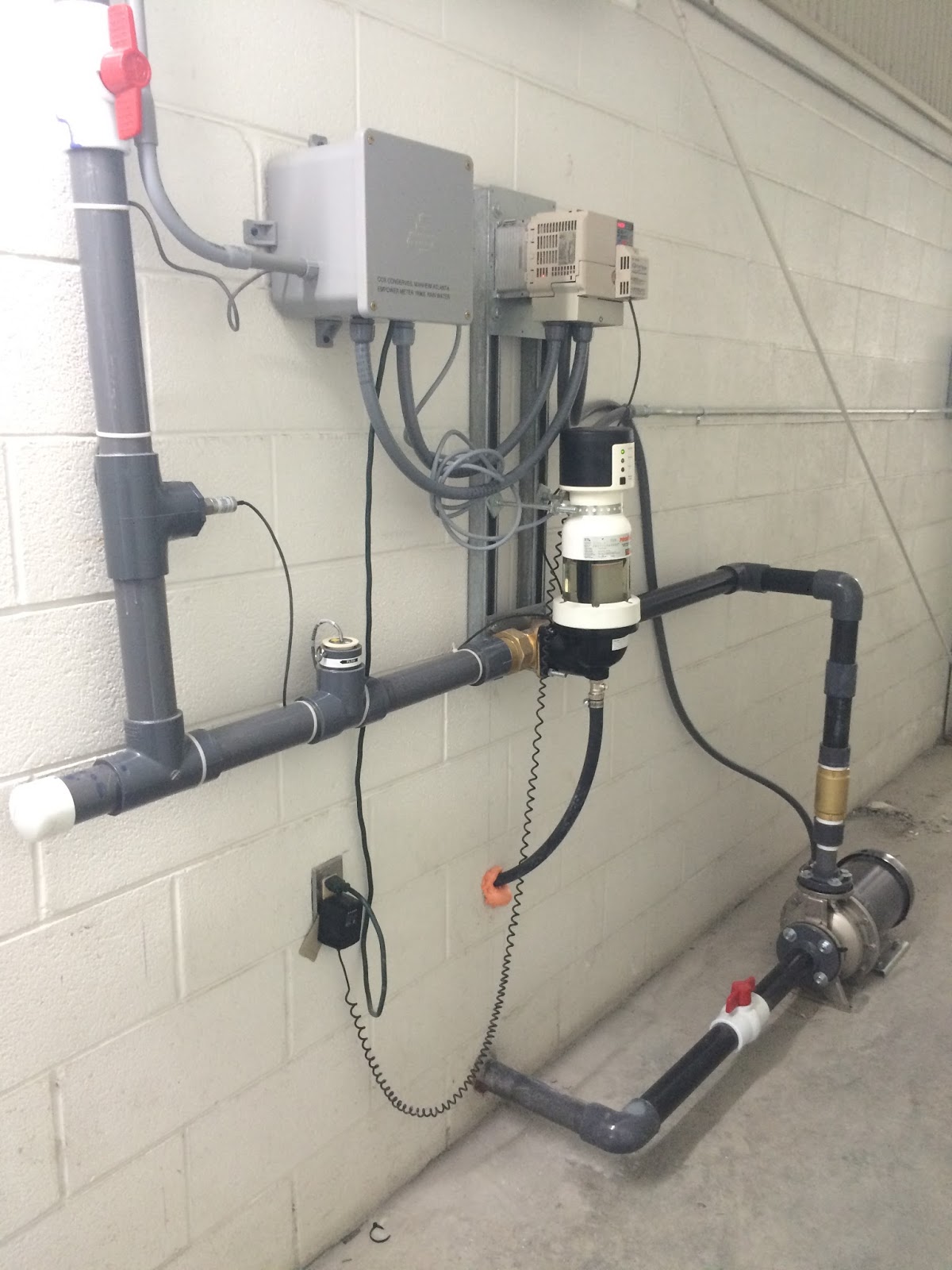
Inside, here is the pump, VFD, and filter. We use only a 25 micron sediment filter. The city water also requires a filter, PLUS a water softener. Rainwater is very soft already, so, spotless rinse!
Wednesday, June 24, 2015
Budgeting a Residential Rainwater System for Irrigation
Some Rules of Thumb
 Every week, you'll need 1 gallon of water for every 2 square feet of annuals or turf that you want to irrigate. Natives need much less.
Every week, your rooftop can collect about 1 gallon for every 2 square feet, on average in Georgia.
The problem is, we don't get the same amount of rain every week, as you know. So how big a tank is ideal? It's a tough question to answer, since one part of the equation is predicting the weather for the next 10-20 years. Another part is predicting water rates for the next few decades. And finally, we need to predict watering restrictions and the outcome of the multi-state "Water War."
We have a modeling app, based on expected demand and rainfall rates. But a quick way to size the tank is to collect FROM a square foot of rooftop for every square foot of annuals or turf we want to irrigate, and size the tank for 1 gallon/square foot collected.
Your rainwater system will cost about $4/gallon installed, plus the piping to route the water to the tanks, and an irrigation system to distribute the water. Add another $2/gallon for underground tanks.
Monday, June 22, 2015
Reference Job: Residential Rainwater Harvesting
This job used 2 - 1750 gallon tanks, which is a good size for the irrigation area and rooftop.

This was the irrigation contractor's first rainwater harvesting job. We spend as much time as requested on-site, showing the installers how to do it right, and that everyone understands how it works. The technology isn't new, we just put things together in a different way.
The Intewa Purain filter fit great just below the manway. There's enough space to move past the the filter to get to the tank. The pump goes here also. We show the contractor how to pipe and wire it so that someone can access the tank through this same hole.

Burying the tanks.

We have found that homeowners like to know how much rainwater they are using. So we installed a meter

The finished product. Ready for the Tour of Homes.

Time from first customer contact to fully installed: less than 4 weeks.
Commissioning time: 15 minutes to connect pump to power and reset the circuit breaker. Usually City of Atlanta water pressure is very high, but in this case, our rainwater pump was even better!
See if you can find it here.
Wednesday, June 10, 2015
Rainwater Harvesting Solves LA Drought?
If a blue collar community in Los Angeles County can find and afford to use rainwater to supply most of its needs, then really, nobody has any excuse.
http://www.yesmagazine.org/issues/cities-are-now/los-angeles-imports-nearly-85-percent-of-its-water
Subscribe to:
Posts (Atom)