Of course. People have been collecting and drinking rainwater for centuries.
Is it legal to collect rainwater at your home and drink it? Yes, but if you want to keep yourself and your guests healthy, some level of treatment is necessary. Here are the steps in a modern rainwater collection and treatment system:
1. Prefilter. Keeping the leaves and sticks out of the cistern is the most important step to keeping water safe. Any significant amount of organic material will eventually go septic and make the water stinky.
2. Cistern (tank). Keep the water cool and dark, so that algae and mosquitoes don't grow.
3. Cistern Piping. Prevent mosquitoes from leaving, and critters from entering. Bring new, freshly aerated, water in at the bottom of the tank, without stirring up any debris at the bottom. Pump outlet piping should be a few inches off the bottom.
4. Final Treatment. We recommend a combination of carbon filtration and UV sterilization. Chlorine isn't necessary with this pair, but it can work instead of them. There are some problems with chlorine in general, and getting the right level is tricky. So we recommend carbon and UV. A sediment filter upstream of the carbon and UV helps the carbon last longer.
Drawings and other resources are here:
http://www.georgiawatertanks.com/rainwater-harvesting-detail-drawings-cad.html
Thursday, January 23, 2020

Is It Illegal to Collect Rainwater?
Short answer, NO. For any state other than Colorado, rainwater harvesting is LEGAL.
Even Colorado allows 2 - 50 gallon rain barrels.
Another example often giving is a person in Oregon who built 3 PONDS on his property without getting permits. Dam permits are required in most states, so that's not unusual.
Other than that, rainwater harvesting is permitted, even encouraged. Providing that you get the required building permits and follow building codes.
For our usual recommendations for rainwater harvesting at your home, see
http://www.georgiawatertanks.com/residential.html
Even Colorado allows 2 - 50 gallon rain barrels.
Another example often giving is a person in Oregon who built 3 PONDS on his property without getting permits. Dam permits are required in most states, so that's not unusual.
Other than that, rainwater harvesting is permitted, even encouraged. Providing that you get the required building permits and follow building codes.
For our usual recommendations for rainwater harvesting at your home, see
http://www.georgiawatertanks.com/residential.html
Thursday, August 15, 2019
Water Storage Tanks for Parking Lots
Parking Decks provide a wide range of possibilities, because we could build something underground, or use the deck as a foundation for something considered above-ground. Most of what I see is concrete, integrated into the structure itself. It's a compelling argument, to use some part of the structure that isn't suitable for anything else.


Option 1 - Underground Fiberglass

Advantages:
Space-efficient
20 year warranty
Shortest installation period
Disadvantages:
Disadvantages:
Size limited to what can be trucked (can be ganged together)
First cost - $2-3/gallon
12 week lead time
Option 2 - Concrete
Advantages:
Space efficient
First Cost
No size restrictions
Disadvantages:
Leaks are common
Limited warranty
Example: NCR Headquarters (used area under a ramp)
Option 3 - Above-Ground Plastic
Advantages:
Lowest first cost up to 10-20,000 gallons
8 Year warranty
Shortest installation period
Repairable
Aesthetics
Disadvantages
Size limited to 10,000 gallon (but can be ganged together)
Vertical cylinder shape
Material handling if must be replaced
Example: 1230 Peachtree St
Option 4 - Above Ground Corrugated Steel
Advantages:
Lowest first cost 10-20,000 gallons and larger
20 year warranty
1 week installation period
4-8 week lead time
Material handling if must be replaced (or moved)
Disadvantages:
Space inefficient - Vertical cylinder shape (use flat roof option)
Option 5 - Above-Ground Panel Tank

Advantages
Space efficient rectangular shape
Unique footprints possible to work around columns, etc.
1 week installation period
Disadvantages:
Higher cost - $2-3/gallon
12 week lead time
Example: Interface Headquarters
Wednesday, March 14, 2018
Rainwater not Desalination
Conventional wisdom is that people use about 100 gallons per day of water. My family averages less than 50, but maybe 100 GPD includes water use embedded in things we buy or use. About 350,000,000 people live in the USA. So adding the data on rainfall from this page, the Lower 48 receive about 100x the amount of water needed. That’s pure water desalinated and transported without any man made energy. Just need to be more efficient in collecting it.
That’s where rainwater harvesting comes in. Most every single-family home could collect enough water to meet the needs of the residents, especially when combined with graywater treatment and reuse. The technology is mature and reliable, and becoming more affordable every year. The process is specified in plumbing codes. The products are certified by independent third parties.
That’s where rainwater harvesting comes in. Most every single-family home could collect enough water to meet the needs of the residents, especially when combined with graywater treatment and reuse. The technology is mature and reliable, and becoming more affordable every year. The process is specified in plumbing codes. The products are certified by independent third parties.
Friday, January 6, 2017
Rainwater Harvesting Grants for Nonprofits

For religious organizations, Georgia Interfaith Power & Light, gipl.org, offers energy efficiency grants, but not for water. Yet! Please contact and encourage them here!
They also offer rainbarrel workshops. For more information, click here. Here's hoping that they don't use translucent rain barrels anymore!
Thursday, December 29, 2016
Rainwater Harvesting for Community Gardens
Another community garden is ready for the rain! We do some installations ourselves, but our goal is to teach contractors how to add rainwater harvesting to their portfolio of services.

Like many of these community gardens, this school takes water from a single downspout. A 4" pipe brings rainwater to an above-ground tank, which has a basket-style prefilter. Yes these require cleaning, but they are most popular. A typical rainstorm will fill the tank.
This project didn't use a pump, but most do.

Like many of these community gardens, this school takes water from a single downspout. A 4" pipe brings rainwater to an above-ground tank, which has a basket-style prefilter. Yes these require cleaning, but they are most popular. A typical rainstorm will fill the tank.
This project didn't use a pump, but most do.
Saturday, September 17, 2016
Drought Returns to Georgia

This the current condition in Georgia. We are again in a Level 1 Drought as of September 2016. The area under Moderate Drought or higher has doubled from 20% of the state last year this time, to 40%. No additional watering restrictions have been added so far.
What should I do?
We all want nice green lawns, but grass is the most easily replaced part of the landscaping. It's more important to protect trees and shrubs. However, the condition of the grass is a good indication of the moisture available to all the landscaping, IF WE WATER EVENLY. So when you water, cover the whole yard!
There are various methods for conserving water in irrigation: some use weather data downloaded from NOAA. Others measure sunlight intensity, temperature, humidity, and the presence of rainfall. Others use soil moisture content. We will be experimenting with this, but my preference is always a direct measure of the desired result. So, moisture sensors. However, sensor quality can be highly variable no matter what kind, especially something mass produced for consumers.
And of course, collect rainwater! If drought levels worsen, there's a real possibility of a total outdoor watering ban. How can a rainwater system help? Even the worst droughts in Georgia are a 50% reduction of rainfall. Which means that most buildings can double their effective rainfall with a rainwater system, which should be enough to protect trees and shrubs.
Please contact Georgia Water Tanks for help protecting your valuable landscaping. Our primary business is supplying equipment to contractors, with design assistance and on-site support during installation and commissioning included. If you are a property owner and are looking for an installer, we can recommend several that are experienced installers. And we are always looking to train more!
Friday, April 29, 2016
Rainwater Harvesting Laws and Incentives - State by State
"Check your local laws before collecting rainwater. . . it's illegal in some states!" How many times have we heard that dire and vague warning. The truth is quite different. Click here to see the current laws for your state.
Saturday, January 9, 2016
Purain Filters USA
Our online partner and official web provider of prefilters RainHarvesting Supplies, has created a new online home for Purain Filters USA. Check it out here: http://www.purainfilters.com/

Wednesday, November 18, 2015
A Simple Design for Stormwater Compliance - New Homes
This design is for new single family homes, or small commercial properties, up to about 10,000 s.f. of impervious surface (rooftops and driveways). You will find that the cost is as low as any approved stormwater management method, plus you will collect about 20 gallons/square foot of impervious surface.

 You'll need 1 for every 1800 square feet of impervious surface. If you have a fraction the round up (e.g. 4100 s.f. / 1800 = 2.27; you'll need 3) The dimensions are 14' long x 5' wide. They can be buried 6" - 48" deep.
Infiltrator tanks do not require gravel backfill or other soil amendment, provided that the soil is no more than 70% clay. Interconnect the tanks with 1" - 2" flexible PVC.

 The 4" Purain filter is suitable for about 1800 square feet also. Plan on a filter in each tank.
This means that you will need a manhole for each tank. If you have 3-5 tanks and don't want so many manholes, then choose a single, larger, Purain HD for direct burial.

The pump will need a floating filter intake, as shown in the photo, to maximize water quality.
Georgia Water Tanks provides design assistance and on-site installation supervision for all packages.
.

Sizing the Infiltrator Below-Ground Tank

Infiltrator tanks do not require gravel backfill or other soil amendment, provided that the soil is no more than 70% clay. Interconnect the tanks with 1" - 2" flexible PVC.

In-Tank Prefilter

This means that you will need a manhole for each tank. If you have 3-5 tanks and don't want so many manholes, then choose a single, larger, Purain HD for direct burial.
Conveyance
Pipe from the downspouts to the tank location with SDR 35 pipe. If you have multiple filters, you'll need a header at the tank to distribute the water.Pumping
A submersible pump with a floating filter intake will send the water to your irrigation system. A pressure-activated pump will start whenever the irrigation heads open, and also if you have a hose connection. They will also start and run continuously if you have a leak in your irrigation system. We can also synchronize the pump start with the irrigation controller. We can put a timer switch next to a hose connection. We like the second method a little better, but either can be best.The pump will need a floating filter intake, as shown in the photo, to maximize water quality.
Standby Connection
Two common methods are a pressure regulating valve (PRV) or a solenoid valve. Either is acceptable in residential systems. Solenoid valve systems cost a little less conserve city water pressure better; PRV's are more readily available, last longer, and easier to service.Standby Connection Protection
Most municipalities are currently requiring an RPZ backflow preventer or air gap at a standby connection, unfortunately. We have new evidence that the rainwater does not contain any known contaminants, and would love to discuss this with your plumbing inspector. We would recommend a dual check valve, if that is typically an acceptable level of protection for a residential irrigation system. Dual check valves can be buried, which makes them easier to install. RPZ backflow preventers must be installed inside, or in an above-ground insulated and heated enclosure. Air gaps require re-pumping and therefore waste energy.Georgia Water Tanks provides design assistance and on-site installation supervision for all packages.
.
Wednesday, September 30, 2015
Reference Job: Commercial Rainwater Harvesting for Vehicle Wash or Cooling Tower Makeup
This facility washes luxury cars, in preparation for auction to dealers. They clean 1500 - 2000 cars/week, so obviously water is a large cost of doing business.
Preparing the pad for the above-ground steel tank. A concrete foundation is not required, but we did want something level. It turned out to be more digging than we thought, to get through the asphalt of the parking lot, down to solid ground.

We erect the tank by first building the top ring of the wall, then adding the roof sheets.

We then jack up the assembly, and add the next ring of wall panels.

We put the Purain filter inside the tank, for a cleaner look. We should have done this before we added the second wall ring. Continuous improvement!


Next we add the PVC liner inside the tank. It's like changing your sock while wearing your shoe.

Piping penetrations are 2 flanges, sandwiched and sealed on the liner. Here's the finished tank.

Inside, here is the pump, VFD, and filter. We use only a 25 micron sediment filter. The city water also requires a filter, PLUS a water softener. Rainwater is very soft already, so, spotless rinse!
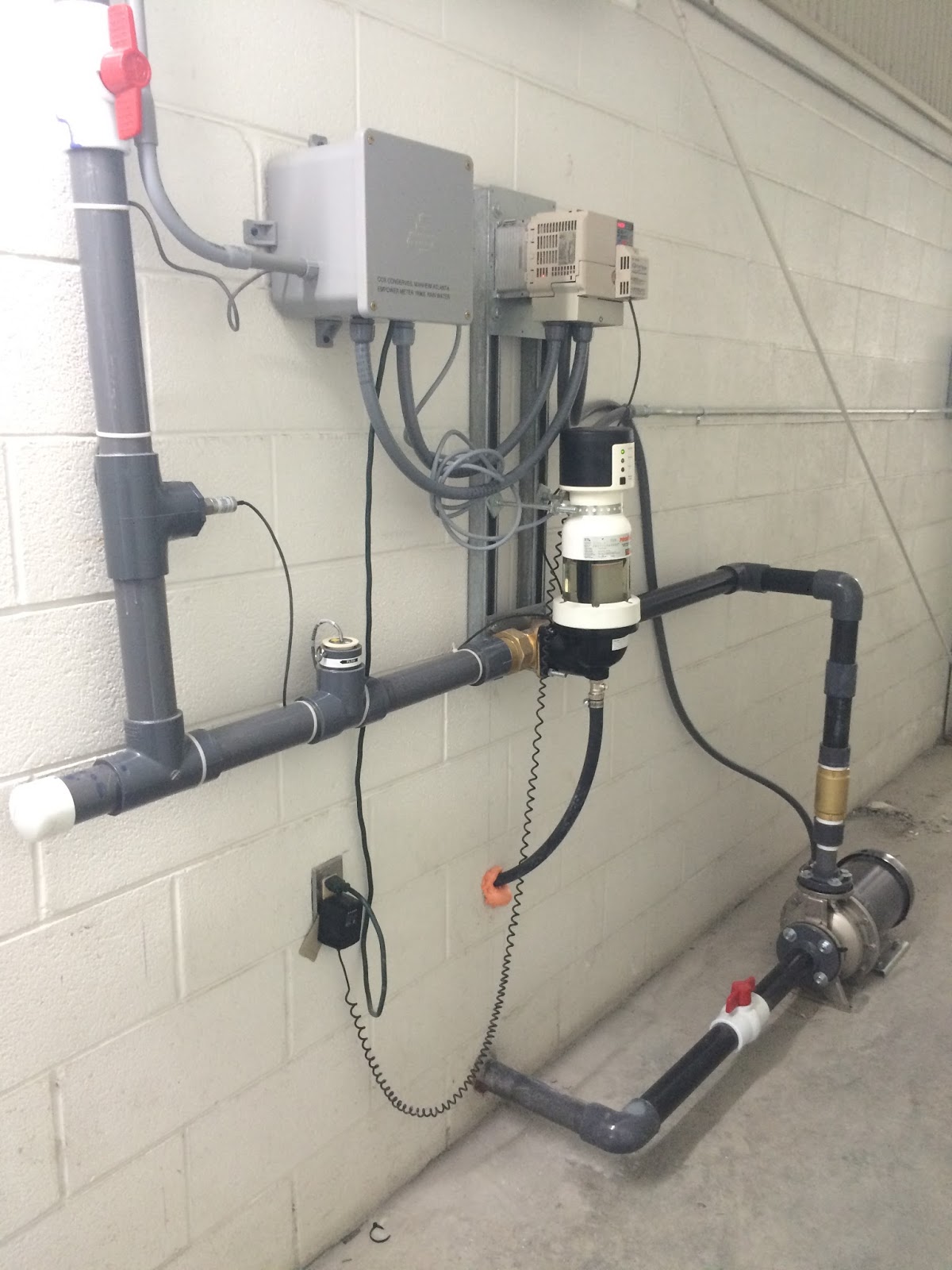
Wednesday, June 24, 2015
Budgeting a Residential Rainwater System for Irrigation
Some Rules of Thumb
 Every week, you'll need 1 gallon of water for every 2 square feet of annuals or turf that you want to irrigate. Natives need much less.
Every week, your rooftop can collect about 1 gallon for every 2 square feet, on average in Georgia.
The problem is, we don't get the same amount of rain every week, as you know. So how big a tank is ideal? It's a tough question to answer, since one part of the equation is predicting the weather for the next 10-20 years. Another part is predicting water rates for the next few decades. And finally, we need to predict watering restrictions and the outcome of the multi-state "Water War."
We have a modeling app, based on expected demand and rainfall rates. But a quick way to size the tank is to collect FROM a square foot of rooftop for every square foot of annuals or turf we want to irrigate, and size the tank for 1 gallon/square foot collected.
Your rainwater system will cost about $4/gallon installed, plus the piping to route the water to the tanks, and an irrigation system to distribute the water. Add another $2/gallon for underground tanks.
Monday, June 22, 2015
Reference Job: Residential Rainwater Harvesting
This job used 2 - 1750 gallon tanks, which is a good size for the irrigation area and rooftop.

This was the irrigation contractor's first rainwater harvesting job. We spend as much time as requested on-site, showing the installers how to do it right, and that everyone understands how it works. The technology isn't new, we just put things together in a different way.
The Intewa Purain filter fit great just below the manway. There's enough space to move past the the filter to get to the tank. The pump goes here also. We show the contractor how to pipe and wire it so that someone can access the tank through this same hole.

Burying the tanks.

We have found that homeowners like to know how much rainwater they are using. So we installed a meter

The finished product. Ready for the Tour of Homes.

Time from first customer contact to fully installed: less than 4 weeks.
Commissioning time: 15 minutes to connect pump to power and reset the circuit breaker. Usually City of Atlanta water pressure is very high, but in this case, our rainwater pump was even better!
See if you can find it here.
Wednesday, June 10, 2015
Rainwater Harvesting Solves LA Drought?
If a blue collar community in Los Angeles County can find and afford to use rainwater to supply most of its needs, then really, nobody has any excuse.
http://www.yesmagazine.org/issues/cities-are-now/los-angeles-imports-nearly-85-percent-of-its-water
Sunday, May 17, 2015
Freeze protection for rain barrels another small aboveground water tanks
Hello from Atlanta, where it's currently 10°F above zero. So strange to have to clarify that it's above zero versus below, but this is the second cold winter in a row here. I thought I'd give a report on the freezing activity overnight. Yesterday the high was about 30 to 35°. Then about 5 o'clock, the temperature started to drop Oakley, and lows were about 10.
This morning when I went out to check my full 500 gallon water tank, there was a layer of ice only about one half an inch thick. FYI, the tank is next to the house, at a low point in the yard, and generally protected from the wind. So in a protected location.
This morning when I went out to check my full 500 gallon water tank, there was a layer of ice only about one half an inch thick. FYI, the tank is next to the house, at a low point in the yard, and generally protected from the wind. So in a protected location.
Saturday, November 22, 2014
Yet Another Combined Sewer Overflow in Atlanta
Yet another big public works project
Fails in less than a year (scroll down a few articles)
As an aside, I note with interest that this spill isn't more broadly reported. Who knows how many of these overflows happen with every storm in Atlanta.
Targeted rainwater harvesting in the appropriate watershed is the fastest and least expensive method for reducing stormwater surges. Controls can be added to utilize the water before the next rain, or just put a small hole in the tank to release the water over a few days.
If the release was from overflow, then the 5500 gallon spill could have been prevented for as little as $5000. When is Georgia going to realize that big public works projects are no longer the solution?
Why won't government incentivize property owners to install cisterns? Is it a lack of supporting federal funding? Cronyism? Lack of experience?
Rainwater is a resource, not a problem to be managed.

Tuesday, October 7, 2014
Where Does Drinking Water Come From?
Take a large body of water

Use solar power to desalinate and purify it.

Transport it using wind energy

And deliver it weekly

This is the where most drinking water comes from.
Question is: do you want the last miles to be this:

to where it's treated,
and then pumped through this

Or is it better to pick it up here

put it directly into here

and treat the water as it's used?
Thursday, August 14, 2014
Stormwater Management Costs in Atlanta, Roswell, and Hapeville
These pavers are the only ones we could find for sale on the internet. They look nice; I might buy them for myself when it's time to replace my driveway. But the owner is concerned about high heels getting stuck in the spaces. And let's compare prices:


By comparison, an above-ground corrugated steel tank, with the pump and controls necessary to integrate with an irrigation system can be found on the internet for an average of. . . $1.12/ square foot.

A below-ground steel tank, costs a little more than above-ground, and installation is more. Maybe $3/gallon, installed.
Sure, there's a cost for the space for an above-ground tank. And if you don't already have an irrigation system, you'll need to add that cost. And Home Depot doesn't always have the lowest prices when buying large quantities. But still, $125 vs. $1.12 or $3???
UPDATE: Received some immediate feedback on this blog entry. Pervious pavers on commercial jobs are available for $8 - 18/square foot. Still, rainwater harvesting is much, much less expensive.
Subscribe to:
Posts (Atom)